Sinking funds: how to save for the expenses that are not monthly
Sinking funds turn irregular costs like car insurance, repairs and holidays into small monthly savings, with a worked example and catch-up math.
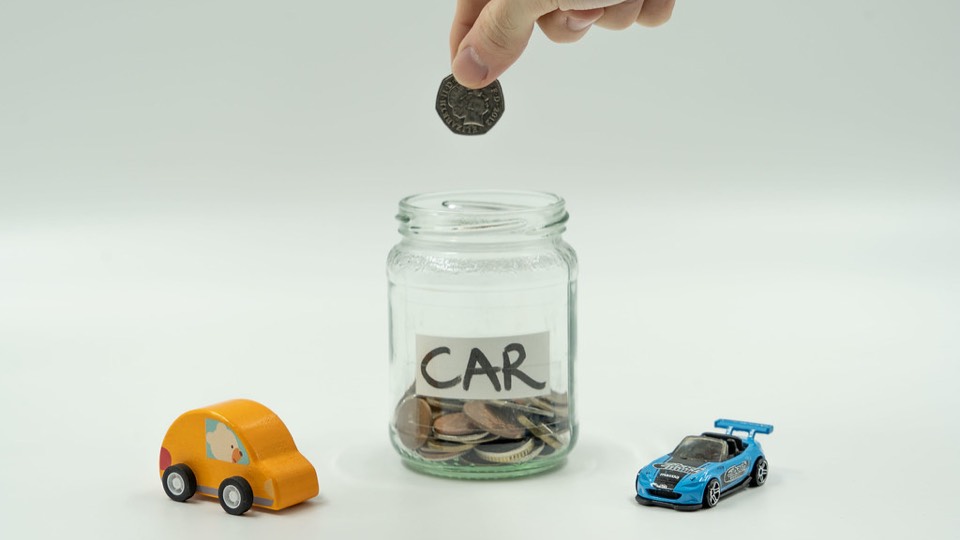
Most budgets handle rent and groceries fine. What breaks them is the car insurance premium in March, the new tires in June and the holidays in December: costs that are predictable over a year but land all at once. A sinking fund turns each of those lumps into a small monthly transfer, so the bill is already paid for when it arrives.
Why irregular costs end up on credit cards
The Federal Reserve's survey of household finances for 2025 found that 63% of US adults would cover a hypothetical $400 expense with cash or its equivalent, the same share as in 2024. Put the other way, more than a third would have to cover it some other way, or could not cover it at all.
Many "surprise" expenses are not surprises at all. You know the insurance renews every year, the car needs maintenance, and gifts come due on the same dates. When there is no money set aside, these costs go on a credit card, and at typical card rates the balance grows while you pay it off. Our guide to credit card interest shows how quickly that adds up.
Sinking fund vs emergency fund
They both sit in savings, but they do different jobs.
| Sinking fund | Emergency fund | |
|---|---|---|
| Covers | Costs you can see coming: premiums, registration, holidays, annual fees | True unknowns: job loss, medical bills, a sudden big repair |
| Target size | The exact cost of each item | Several months of essential spending |
| How you use it | Spend it on schedule, then refill | Spend only in a real emergency, then rebuild |
The CFPB describes an emergency fund as cash set aside for unplanned expenses or financial emergencies, and suggests setting your own rules for what counts. A simple rule: if you could have put it on a calendar, it belongs in a sinking fund. That keeps your emergency fund intact for the things you could not have planned.
How to set up sinking funds
1. List every non-monthly cost
Go through 12 months of bank and card statements and pull out anything that is not paid monthly. The CFPB's annual planning tool suggests looking for bills paid once, twice or a few times a year, such as insurance paid quarterly or yearly, vehicle and property taxes, back-to-school shopping, holiday gifts, travel to see family, and major purchases like appliances or home repairs. Add annual subscriptions and memberships, which are easy to forget because they renew automatically.
2. Put a number and a due month on each
Use last year's actual amount, or the renewal notice if you have it. For costs with no fixed date, such as car repairs, use a yearly estimate and spread it evenly.
3. Work out the monthly amount
For a cost that repeats every year, the long-run monthly amount is simply the yearly cost divided by 12. But if the next bill is only a few months away, dividing by 12 will not get you there in time. In the first year, divide by the number of monthly deposits you can make before the due date instead. After the bill is paid, drop back to the divide-by-12 amount.
4. Decide where the money lives
You do not need six bank accounts. Many online banks let you create named savings "buckets" inside one account; a single savings account plus a spreadsheet works just as well. Keep it separate from checking so the money is not spent by accident, and make it an insured, easy-access account, because you will use it several times a year. See where to keep your cash for the options.
5. Automate it
The CFPB calls recurring transfers through your bank or credit union one of the easiest ways to save consistently. Schedule the total sinking-fund transfer for the day after payday.
Worked example: six irregular costs
Assumptions for illustration only: the costs and due months below are invented to show the method. Saving starts with the October 2026 paycheck, there is one deposit per month, and the deposit in the due month counts. Monthly amounts are rounded up to the next dollar.
| Fund | Yearly cost | Next due | Deposits until due | Long-run monthly (cost ÷ 12) | First-year monthly (catch-up) |
|---|---|---|---|---|---|
| Car repairs and maintenance | $900 | Any time | 12 | $75 | $75 |
| Car insurance (annual premium) | $1,140 | March 2027 | 6 | $95 | $190 |
| Holiday gifts and travel | $800 | December 2026 | 3 | $67 | $267 |
| Annual subscriptions | $240 | May 2027 | 8 | $20 | $30 |
| Car registration | $150 | August 2027 | 11 | $13 | $14 |
| Summer vacation | $1,500 | July 2027 | 10 | $125 | $150 |
| Total | $4,730 | $395 | $726 |
What the table tells you:
- The real cost of these items is $395 a month. That is the number to put in your budget permanently. If it looks high, that is usually because these costs were never in the budget to begin with.
- Starting late costs more per month, not more in total. Because the holidays are only 3 deposits away, that fund needs $267 a month now instead of $67. So the monthly total starts at $726, which is $331 more than the long-run amount.
- The catch-up shrinks fund by fund. Once each bill is paid, that fund drops to its long-run amount, so the monthly total falls during the year until it settles at $395.
If the catch-up total does not fit your budget, choose. You can pay this year's nearest bill partly from savings or cut its size (a smaller holiday budget), and start the other funds at their long-run amounts. What you want to avoid is the same bill landing on a credit card every year.
Common mistakes
- Using the emergency fund as a sinking fund. It drains quietly and is empty when a real emergency hits.
- Skipping the "boring" items. Car registration and annual subscriptions are small, but together they add up.
- Not refilling after spending. A sinking fund only works if the monthly transfer keeps going after the bill is paid.
- Too many categories. Start with the five or six biggest. You can split them later.
What to do this week
- Pull up the last 12 months of bank and card statements and list every cost that is not paid monthly, with its amount and month.
- For each, calculate the long-run monthly amount (cost ÷ 12) and, for anything due soon, the catch-up amount (cost ÷ deposits left).
- Add the total as a line in your budget and set an automatic transfer to a separate savings account for the day after payday.
General education, not personal financial advice. Figures are illustrations computed from the stated assumptions.
Sources
- Federal Reserve: Economic Well-Being of U.S. Households in 2025, executive summary
- CFPB: Your Money, Your Goals annual planner (Focus on Native Communities)
- CFPB: An essential guide to building an emergency fund
Links checked 9 Oct 2026. Ledgerly is education, not personal financial advice.
 The 50/30/20 budget, worked through
 How big should your emergency fund be?
 Where to keep your cash: savings accounts, CDs, money market funds and T-bills
 Inflation and interest rates: what they do to your savings